
It is not always necessary to test doorsets from both directions. A more appropriate consideration is whether there is sufficient evidence to demonstrate that the doorset will provide adequate fire resistance, regardless of the direction from which a fire may occur.
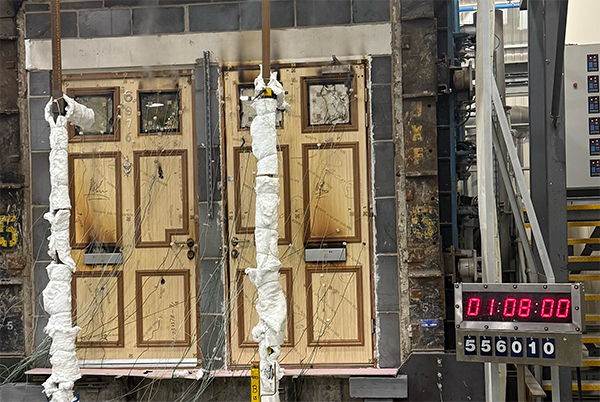
The route to demonstrating this performance can vary depending on the type of evidence available, the certification body and the requirements of the responsible person or end user. However, there are well established principles within recognised standards and guidance documents that can be used to evidence performance in both orientations.
As Wood International Agency Limited, our focus that follows is on timber fire doorsets, although similar principles do apply to some other doorset constructions.
Regulatory Guidance
Approved Document B (England), Appendix C: Fire Doors, states:
At face value, this appears to require testing from both sides for all doorsets. However, this interpretation assumes that every doorset design is physically tested, which is not always the case in practice.
Role of Fire Testing Standards
Fire test evidence remains the foundation of certified and classified fire-resisting doorsets. However, test standards recognise that certain constructions - particularly timber doorsets - exhibit predictable behaviour under fire test conditions.
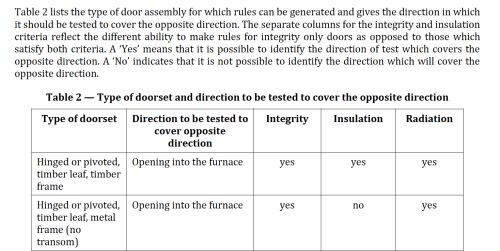
For example, Table 2 of test standard BS EN 1634-1 allows for this known predictability. Timber doorsets are typically tested opening towards the furnace as their performance characteristics can be reliably assessed without the need for testing in both directions.
That said, this approach is subject to specific conditions, including:
- The door leaf must be of symmetrical construction
- Any restraining/supporting hardware (e.g. hinges, closers, locks, latches) must demonstrate performance when exposed from both directions
Any non-symmetrical elements (such as some glass types) and restraining hardware must therefore be supported by relevant test evidence, not necessarily in the same doorset design as tested.
Demonstrating Dual Orientation Performance
Where a timber doorset has only been tested in one orientation, demonstrating performance from the opposite side typically involves some or all of:
- Testing the opposing orientation
- Providing supporting test evidence for any non-symmetrical components
- Ensuring all restraining hardware items have proven fire performance in the opposing direction
Importantly, this supporting evidence does not need to come from identical doorset designs. Engaging with an experienced assessment or classification specialist early in the process is strongly recommended to ensure all available evidence is effectively utilised.
Are Assessments Acceptable?
Yes—assessments are a recognised and compliant route to demonstrating fire performance.
Standards such as BS EN 1634-1 (Section 13: Field of Direct Application) explicitly allow for variations to tested designs, including:
- Changes in size
- Modifications to glazing
- Evaluation of performance in alternate orientations
Further extended application (assessment) standards, such as the BS EN 15269 series (including parts 3 and 20 for timber doors), provide additional routes for assessing variations. Other common routes include:
- Field of Application reports concluding to BS 476-22
- Certifire documents (TS10 door certificates are also assessments concluding to BS 476-22)
The Value of Third-Party Certification
Third-party certification provides an additional level of assurance. Tested and assessed Certified product designs can be subject to ongoing audit testing where any adverse results can be reviewed by assessment bodies to refine and update supporting documentation.
This process helps ensure that products placed on the market continue to meet the required fire performance standards, offering increased confidence to specifiers, installers and end users alike.
You will find test reports with Wood International Agency Ltd door products with specimens opening both towards and away to the furnace, with certified scope documents in accordance with the principles and standards above. If you want to discuss any aspect of our test evidence, get in touch!